Eira Lowri Pritchard - a Welsh-born Homo Magus mutated by exposure to post-Reset interdimensional radiation. A master of psychic and demonic sorcery, she leads an underground empire in Cymru, combining traditional Celtic witchcraft with advanced neurotech and quantum telekinesis. Regarded as one of the most dangerous magical entities on Eden.
Yancuictitlan
"The Place of the New Beginning"
Identity and Continuity
Yancuictitlan is the sovereign capital of the Mexica-descended civilization within Cemanāhuac, constructed as the direct cultural and ideological successor to Tenochtitlan. It is not a reconstruction. It is a continuation under new conditions. The name itself signals intent: not restoration of the past, but a deliberate rebirth that carries memory forward without imitation.
Where Tenochtitlan proved mastery over environment, Yancuictitlan demonstrates integration with it.
Geographic and Structural Design
The city is positioned at the center of a vast inland lake spanning approximately 13,512 square kilometers. The shoreline is functionally irrelevant to daily life; the city operates as a self-contained hydrological and ecological system.
Its layout preserves the classical Mexica grid: a symmetrical network of canals, causeways, and districts radiating from a central sacred axis. This axis anchors the Grand Pyramid Complex, a reengineered vertical structure combining temple, governance center, data nexus, and astronomical observatory.
The city does not “float” in a simplistic sense. It is built on a network of stabilized, buoyant platforms derived from advanced chinampa principles—layered organic substrates, root-binding systems, and structural latticework reinforced with modern materials. These platforms flex with water movement, making the city resilient to seismic and hydrological disruption.
Energy and Sustainability Systems
Yancuictitlan operates on a hybridized free-energy grid derived from Tesla Coil Collectors integrated into architectural elements. These systems are supplemented—not replaced—by solar arrays, vertical-axis wind towers, and kinetic water generators embedded within canal flow systems.
Agriculture is decentralized and visible. Hydroponic terraces, floating chinampa farms, and vertical food towers are distributed across all districts. There is no separation between “city” and “food production.” Waste is fully cycled through bio-reactive processing, returning nutrients directly to agricultural systems.
Water is not managed as infrastructure. It is treated as a living partner system—filtered, oxygenated, and circulated through layered ecological zones.
Architectural Language
The architecture retains core Mexica geometry: stepped forms, axial symmetry, and cosmological alignment. However, materials have evolved.
Stone is still present, but often fused with glass composites, bioceramics, and living materials that regulate temperature and air quality. Surfaces may appear obsidian-like but function as energy capture arrays or data interfaces. Bioluminescent elements are used sparingly for navigation and ceremonial emphasis, not decoration.
There are no conventional skyscrapers. Verticality exists, but always in stepped or terraced forms that maintain visual continuity with ancestral design principles.
Transportation and Movement
Primary movement occurs via canal systems. Watercraft are modernized but retain traditional profiles for hydrodynamic efficiency. Autonomous guidance systems exist but are unobtrusive.
Pedestrian movement is prioritized through layered walkways, bridges, and green corridors. There are no personal ground vehicles within the central city. Long-distance transit connects through submerged or peripheral systems, keeping the visible city quiet and uninterrupted.
Cultural and Civic Function
The central pyramid complex functions as both spiritual and administrative core. Governance is not physically separated from cosmology; decision-making remains tied to celestial cycles, ecological indicators, and long-term balance metrics.
Markets, plazas, and communal spaces remain central to daily life. These are not preserved traditions; they are active economic and social engines. Trade integrates advanced materials, data exchange, and traditional goods without hierarchy between them.
Defensive and Strategic Design
Yancuictitlan is difficult to approach without permission. The surrounding lake acts as a natural barrier, enhanced by environmental monitoring systems embedded beneath the surface.
Rather than overt militarization, defense is layered into infrastructure: control of water routes, adaptive platform reconfiguration, and environmental manipulation. In extreme scenarios, sections of the city can isolate, submerge partially, or reconfigure pathways to disorient intruders.
Symbolism and Meaning
Yancuictitlan represents continuity without stagnation. It rejects the collapse narrative that typically follows catastrophe. Instead, it demonstrates that cultural systems can evolve without losing identity.
It is not a monument to the past.
It is proof that the past adapted and survived.
Yaomaraogan the Ancient Archimage
Jandamarra Warluwarri - The Ancient Archimage and metaphysical guardian of the Gateway of Eternity. Believed to be the first to channel raw magic through the Dreaming into physical form. Serves as both protector and arbiter of cosmic law; ensures that no being, mortal or divine, tamper with the genesis point of creation.
Yellowstone Super-Volcano
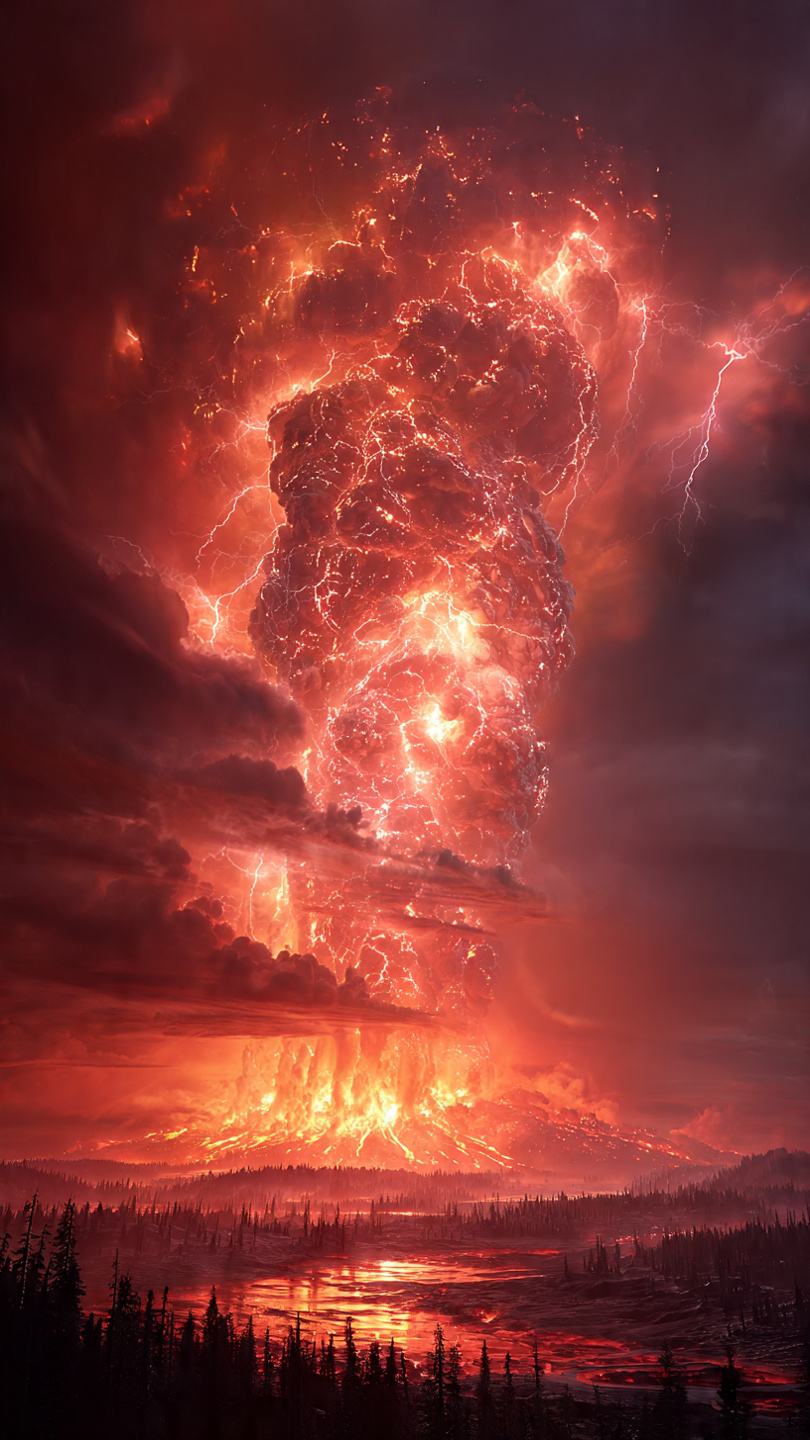
6183-04-26T13:45:00 - The Yellowstone Supervolcano Eruption of 6183 was a planet-altering geological event triggered by a cascade of global seismic destabilization. As tectonic stress redistributed across fault lines worldwide, synchronized earthquake activity intensified pressure beneath the Yellowstone caldera. This culminated in a full-scale super-eruption, releasing thousands of cubic kilometers of magma, ash, and volcanic gases into the atmosphere.
The immediate impact was catastrophic. A pyroclastic surge obliterated the surrounding region within hours, while shockwaves and secondary quakes destabilized large portions of the continental crust. Within days, vast ash plumes spread across the Upper Hemisphere, blocking sunlight and contaminating air, soil, and freshwater systems. Aviation ceased entirely, and long-range communication infrastructure experienced widespread disruption due to atmospheric interference.
In the months that followed, the eruption triggered a severe volcanic winter. Global temperatures dropped sharply as solar radiation was reduced by dense ash and sulfate aerosols. Crop failures became widespread, leading to food shortages and mass migration. Ecosystems collapsed or were forced into rapid adaptation cycles, with many species facing extinction while others emerged in altered forms due to environmental pressure.
Hydrological systems were equally affected. Ash contamination altered river chemistry, poisoned lakes, and disrupted oceanic nutrient cycles. Acid rain events became frequent in affected regions, accelerating infrastructure decay and rendering large areas temporarily uninhabitable.
Despite the devastation, the eruption also marked a turning point. The collapse of pre-existing industrial systems forced surviving populations to adopt localized, sustainable practices. New ecological zones emerged in the decades following, with geothermal activity reshaping landscapes and creating fertile, mineral-rich regions.
The Yellowstone Eruption is widely regarded as a catalyst event in the Great Reset, fundamentally altering climate patterns, geopolitical structures, and humanity's relationship with planetary systems.
Yolŋupaṉa
Jarrah Ngurruwut - Cybernetic guardian and protector of northern Sahul territories. Awakened during the Great Reset from a 60th-century biotechnological experiment, Yolŋupaṉa stands as a fusion of ancestral will and adaptive machine intelligence. Revered among Indigenous communities as a spiritual sentinel and feared by rogue technologists as an implacable hunter, he enforces peace along the desolate frontiers of Sahul.
Yom Kippur
Day of Atonement - The holiest day in Judaism. It occurs on the 10th day of the month of Ulūlu, following Rosh Hashanah, and concludes the Ten Days of Repentance. The observance centers on reflection, repentance, and reconciliation, both with That-Which-Abides and with other people.
The defining practice of Yom Kippur is a 25-hour fast, during which adult participants abstain from food and drink. Additional restrictions include refraining from work, bathing, wearing leather shoes, and marital relations, emphasizing humility and spiritual focus. Much of the day is spent in synagogue services, where communal prayers and confessions are recited repeatedly. Central to the liturgy is the theme of seeking forgiveness for sins committed over the past year.
A key concept of Yom Kippur is that atonement for wrongs against That-Which-Abides can be sought through prayer and repentance, but wrongs against other people must be resolved directly with those individuals before the holiday. This reinforces the ethical dimension of the observance, placing responsibility on personal accountability and restitution.
Traditionally, the day concludes with the sounding of the shofar (a ram's horn), symbolizing closure and renewal. Yom Kippur holds both religious and cultural significance, even among less observant Jews, as a time for introspection and moral recalibration. Its emphasis on forgiveness, accountability, and renewal gives it enduring relevance in both spiritual and social contexts.
Yōm Tərūʿā
Yōm Tərūʿā, meaning "Day of Blasting" or "Day of Trumpets," is a biblical holy day described in the Hebrew Bible and observed on the first day of the seventh month (Ulūlu). It is marked primarily by the sounding of the shofar, a ram's horn instrument, which produces a series of ritual blasts symbolizing awakening, alarm, and remembrance.
In later Jewish tradition, Yōm Tərūʿā became closely associated with Rosh Hashanah, the Jewish New Year, though the biblical framing emphasizes the act of proclamation and sacred assembly rather than a calendar reset. The day is considered a time of spiritual alertness, calling individuals to reflect on their actions and prepare for the period of repentance that culminates in Yom Kippur.
The shofar blasts, traditionally categorized as tekiah (a long note), shevarim (broken notes), and teruah (rapid staccato bursts)—serve as the central ritual element. These sounds are interpreted in multiple ways: as a call to repentance, a reminder of divine sovereignty, or a symbolic alarm urging moral awareness.
Yōm Tərūʿā does not prescribe fasting but is observed as a day of rest and sacred gathering. Its themes of awakening and accountability position it as the opening moment in a broader cycle of introspection known as the Ten Days of Repentance.
Yumi
Katharina Weis - German-born bounty hunter and archery prodigy known for her precise, silent capture operations across Central Europe. Lacking any innate powers, she has achieved superhuman levels of accuracy, spatial awareness, and endurance through discipline and training. Though her work often intersects with criminal elements, her personal motives remain opaque. Recognized under the codename Yumi by international law agencies.

 01.jpeg)


 01.jpeg)
 01.jpeg)
 01.jpeg)